crack numbers
Maintaining a uniformly agreed-upon crack statistics system is a difficult undertaking.
In addition to assessed kills, there are injured animals (which either need to recover or be euthanized) and missing animals, some of which later reappear. Furthermore, compensation is provided on a discretionary basis for so-called indirect damages (losses discovered simultaneously or later in areas with confirmed wolf kills) or for unconfirmed kills.
Definitions
A crack defines a dead animal where a livestock depredation expert has determined that the primary cause of death was an attack by a large predator (the basis for this determination is within his competence as an official expert) and the owner has subsequently been compensated by the federal state for the dead animal.
The definition of a injured animal The result is that the damage assessor found the animal alive and examined/sampled it; it is compensated as an injured animal or at least registered as such by the federal state.
Stray/Missing These are animals that, after a spatial and temporal connection has been established by a livestock damage assessor or the responsible authority, have been compensated by the federal state or at least registered as such.
Figures on livestock kills in 2025
Based on information from experts in each federal state, the Austrian Wildlife Crisis Center (ÖZ) compiles the predation statistics for all of Austria. A distinction is made between killed, injured, and missing animals:
- Killed: The damage assessment determined that the primary cause of death was an attack by a large predator, because the animal was killed directly during the attack or had to be slaughtered in an emergency.
- Injured: According to the tear analysis, the injuries resulted from an attack by a large predator.
- Missing/gone: Animals that have disappeared after a spatial and temporal connection with a livestock kill has been established and have been registered as such by the federal state.
The crack figures listed here are not up-to-date. Final figures can only be provided at the beginning of the following year after all compensation claims have been received by the federal states. Whether and how much compensation is paid is regulated in each individual federal state.
Status: October 2025
The data source is the respective federal state.
Table to follow shortly.
Figures on livestock kills in 2024
Federal States Total
Survey: February 2025
The data source is the respective federal states.
| predators | Livestock species | killed | injured | missing |
|---|---|---|---|---|
| wolf | Sheep/Goat | 203 | 35 | 169 |
| Beef | 17 | 12 | 1 | |
| Horse | 0 | 1 | 0 | |
| Enclosed game | 3 | 0 | 0 | |
| bear | beehives | 23 | ||
| Sheep/Goat | 8 | 1 | 23 | |
| Beef | 1 | 0 | 0 | |
| golden jackal | sheep | 12 | 1 | 5 |
| In total | 267 | 50 | 198 |
Livestock statistics for 2024, sorted by federal state, available for download: ÖZ_Risszahlen_2024_10_BLs
Figures on livestock kills in 2023
Federal States Total
Survey: February 2024
The data source is the respective federal states.
| predators | Livestock species | killed | injured | missing |
|---|---|---|---|---|
| wolf | Sheep/Goat | 460 | 27 | 607 |
| Beef | 20 | 0 | 4 | |
| Horse | 2 | 3 | 0 | |
| Enclosed game | 5 | 0 | 0 | |
| bear | Sheep/Goat | 42 | 0 | 7 |
| golden jackal | Sheep/Goat | 21 | 0 | 35 |
| In total | 550 | 30 | 653 |
Livestock statistics for 2023, sorted by federal state, available for download: ÖZ_Risszahlen_2023_Bundesländer
Figures on livestock kills in 2022
Federal States Total
Survey: February 2023
The data source is the respective federal states.
| predators | Livestock species | killed | injured | missing |
|---|---|---|---|---|
| wolf | Sheep/Goat | 782 | 67 | 920 |
| Beef | 9 | 2 | 0 | |
| bear | Sheep/Goat | 51 | 0 | 66 |
| Beef | 1 | 0 | 0 | |
| beehive | 1 | 0 | 0 | |
| golden jackal | Sheep/Goat | 13 | 1 | 10 |
| Fallow deer | 4 | 0 | 0 | |
| In total | 861 | 70 | 996 |
Livestock statistics for 2022, sorted by federal state, available for download: ÖZ_Risszahlen_2022_Bundesländer
Maps and information on cracks in individual federal states
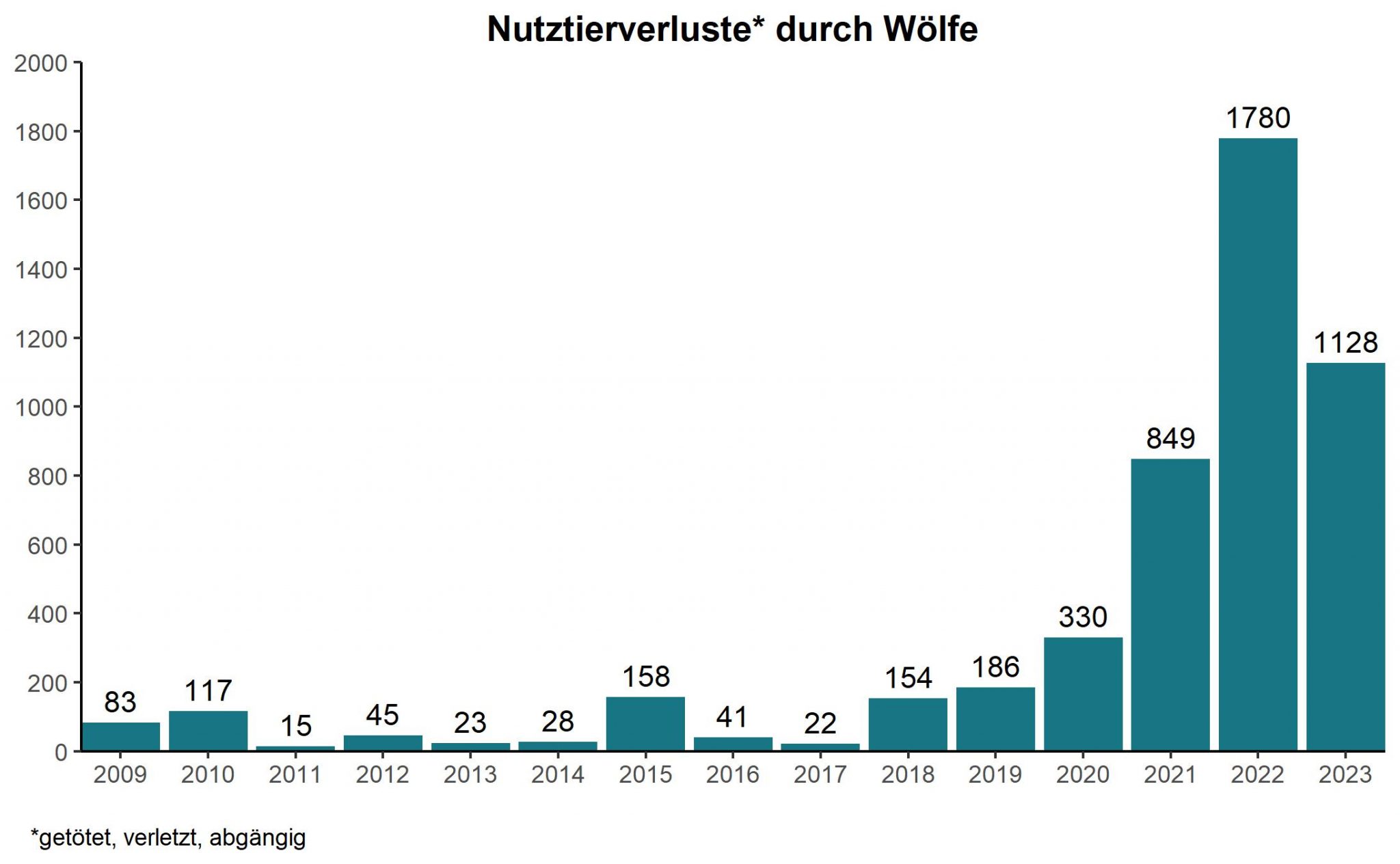
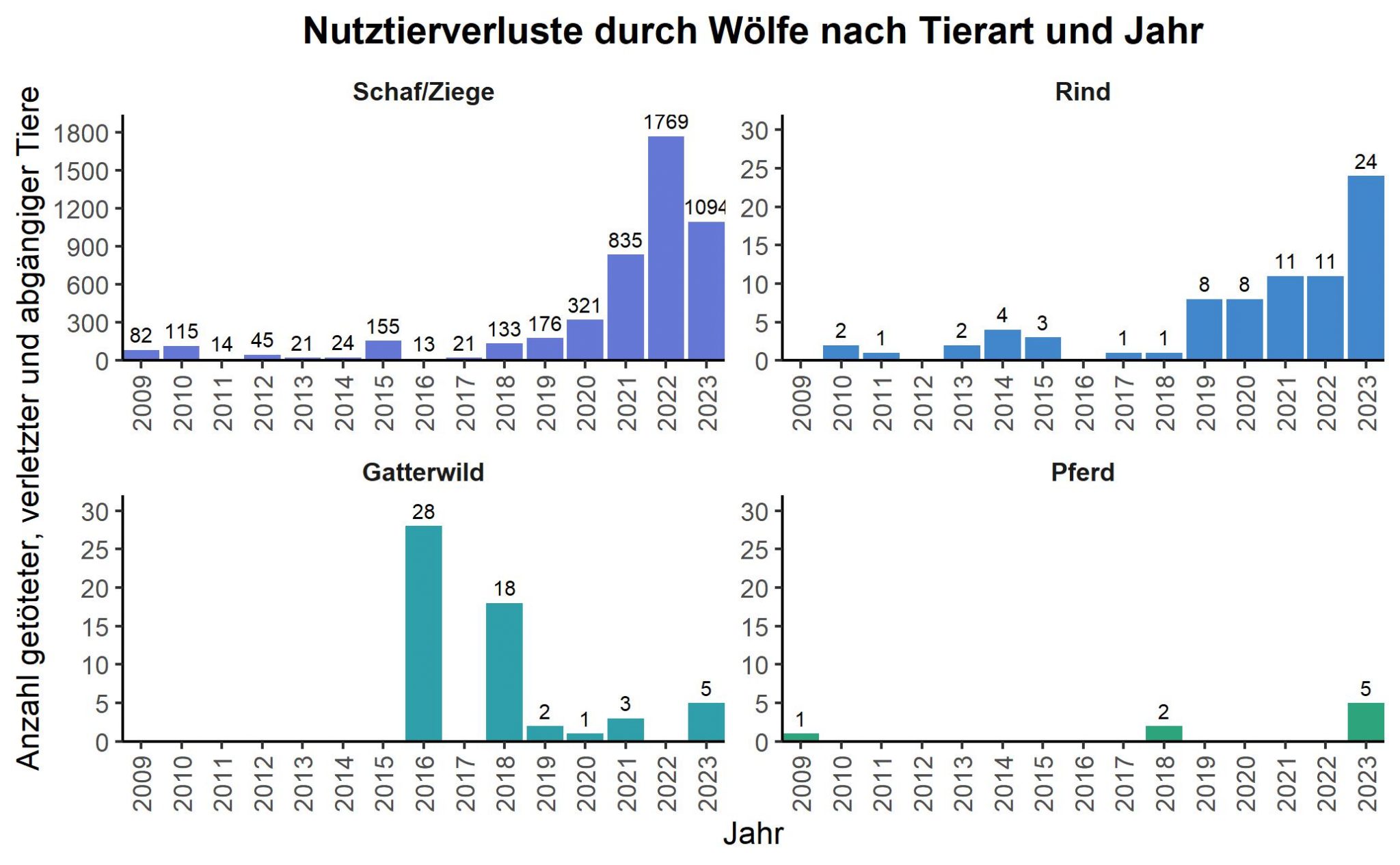
Development of livestock losses due to wolves, 2009–2024
The total losses shown in the graphs (killed, injured and missing/lost farm animals) are based on monitoring data up to 2016, and on compensation reports from the federal states to the Austrian Centre from 2017 onwards.
When wolf populations are low, individual behavioral differences can become highly pronounced. Individual animals can cause many kills within a limited period of their presence, resulting in significant spikes in the crime rate.
As in other European countries, sheep are by far the most frequent victims of wolf attacks on livestock. Goats are similarly at risk, but are much less commonly found in pastures. These two are discussed together below, as goats are not affected every year and then only in very small numbers. Larger, more defensive grazing animals such as cattle and horses are attacked far less frequently. Young animals are more at risk with the latter two species, but adult cattle have also been killed by a single wolf in Austria.