scaring away
Generally
Scaring away means a short-term deterrence of conspicuous individuals. Targeted measures in combination with electric fences can serve as a supplement in acute incidents and at best achieve a localized change in behavior.
Specific, permitted measures must be clarified with the responsible authorities.
Deterrence is based on what is known as aversive conditioning, which creates a link between certain situations and negative experiences such as pain or danger. In this context, these are the presence of humans or proximity to houses or settlements. This link (conditioning) can be achieved through the aforementioned deterrence measures. Simply driving away wolves without lasting negative experiences such as pain or danger is not an aversive conditioning measure, as this only results in a change of location and not a fundamental change in behavior. However, it can certainly have a damage-reducing effect.
Details can be found in the document Wolf Management in Austria: Basics and Recommendations, available as PDF.
In this context, the following terms need to be clarified:
habituation In this context, refers to the animal getting used to the presence of humans. Habituated animals allow humans to get close to them. They have learned that humans are not a threat, but are not aggressive. They do not approach humans on purpose. There is no positive stimulus from humans, the negative stimulus has simply disappeared. Habituated behavior arises through individual learning or is passed on from the parents to the young.
As feed conditioning is the term used to describe the behavior in which animals associate certain situations with the receipt of food. In the area of conspicuous individuals, this means the association of human facilities with available food. Food-conditioned animals seek out these facilities deliberately, without knowing whether there is food there in this specific case, but because it often is. This is therefore a positive stimulus.
There is still little experience in scaring away conspicuous wolves.
Previous experience with “problem bears” in Europe shows that successful deterrence is not a given, but rather the exception. The following recommendations can be derived from this:
- In order to specifically scare away conspicuous wolves or bears, as well as to monitor the success of deterrent measures, it is necessary to radio transmitters on the animals.
- Targeted deterrent measures can be carried out with the aim of maintaining or regaining the fear of humans.
- Targeted deterrent measures can at best achieve a local change in behaviour, which can be used for the targeted, short-term protection of livestock.
- The sooner intervention takes place, the higher the probability of success.
- The animals must be intensively deterred several times over the course of several weeks/months.
- During this time, they should not have any adverse experiences, for example, animals conditioned to food should not be allowed to enter settlements without being frightened away.
- It is easier to achieve aversive conditioning in habituated animals than in food-conditioned animals.
Targeted deterrent measures can be measures for herd protection and damage prevention not replace, only supplement.
Supplementary measures for technical herd protection
The following measures can drive away predators to the maximum, but do not represent a deterrent measure as described at the beginning. They should also not be installed permanently or unchanged for a long period of time. On the one hand, to prevent predators from becoming accustomed to them and, on the other hand, to avoid making the work of livestock guardian dogs more difficult, if they are present.
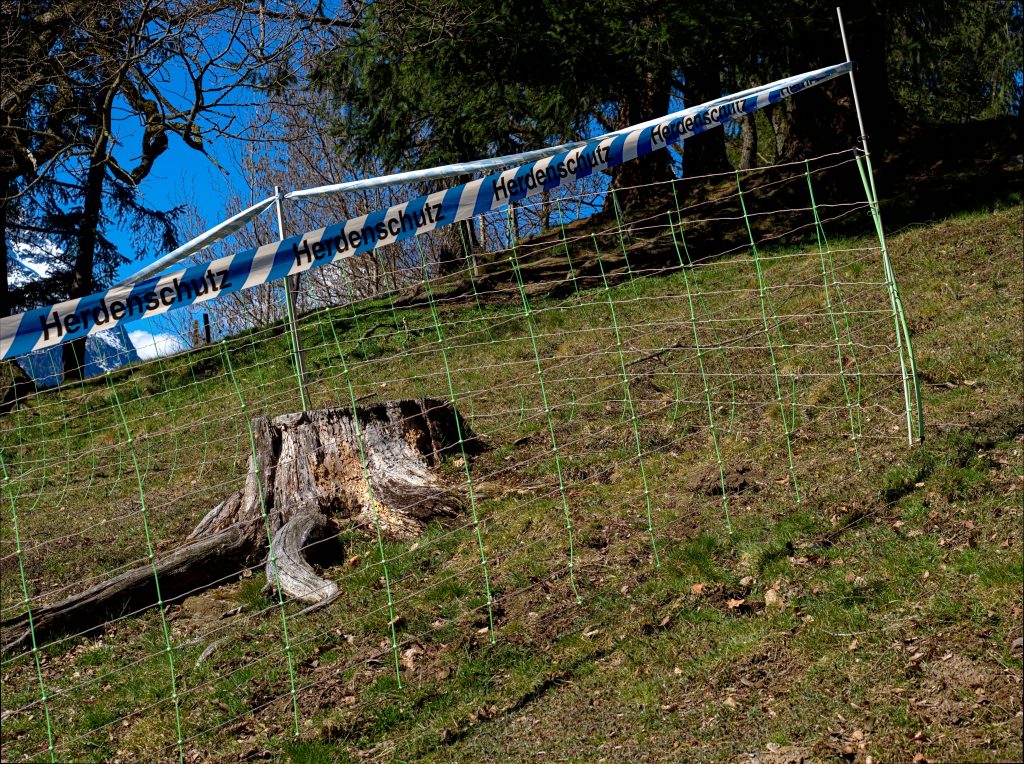
streamers and fladry
The Fladry is a solid line to which clearly visible red ribbons are attached. These are hung on fences. An alternative to the Fladry is flutter ribbons. 20 to 30 cm long ribbons, preferably a blue and white barrier tape, are attached directly to the fence. The ribbons increase the visibility of the fences. Both methods are only useful for electrified fences, but are not suitable for brown bears!
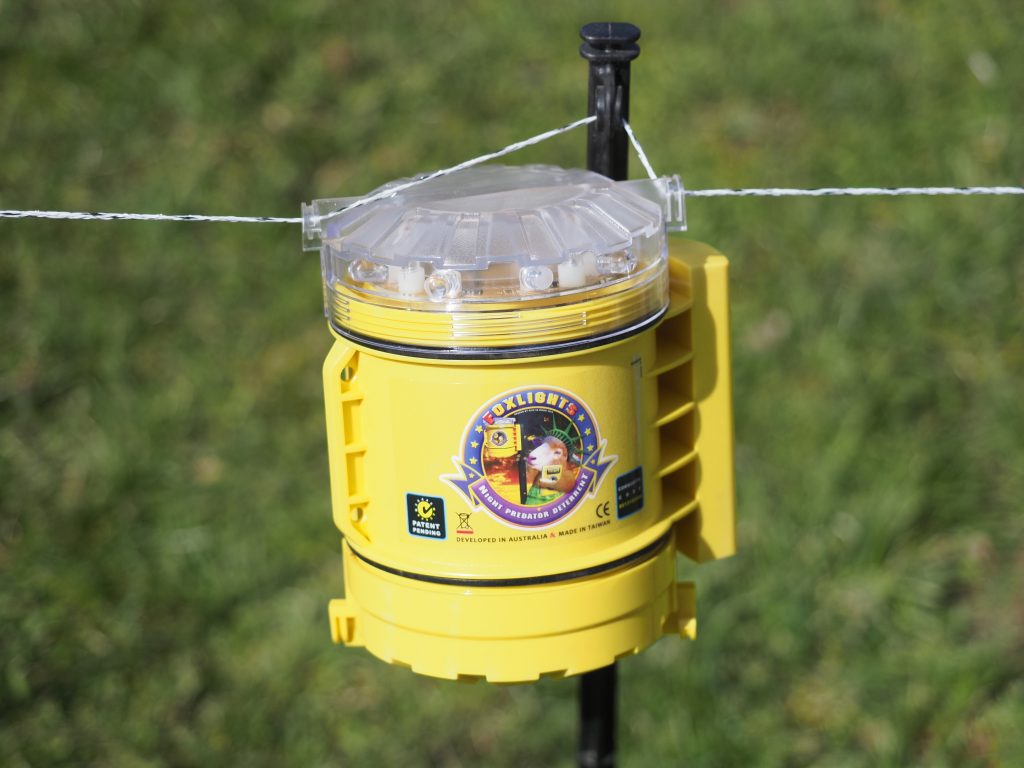
Flashing Lights – Foxlights
If wolves and lynx are present or have already been killed, flashing lights can be used as a short-term emergency measure on existing, well-electrified fences. Normal construction site lights are not suitable; special lights with random generators and color differences are required to delay the predators from getting used to them. They should not be used continuously for more than three to five days at most. By moving the animals around frequently, the habituation effect can be delayed but not prevented.
area controls with dogs
As part of studies in Norway on the use of livestock guardian dogs, a procedure was tested in which a shepherd with one or two dogs regularly patrolled the area where wolf attacks had occurred.
In this way, losses (attacks, accidents, illnesses) were reduced from 15.5% to 2% to 3%. After the end of the study, the dogs were withdrawn and losses immediately increased again. The main advantage of this method was that it could also be used in unfenced areas and was better suited to Norwegian grazing. The shepherd does not look after the sheep, but only checks that the animals are in good condition, checks the fences where there are any, and pays attention to special features in the area. This checking is generally recommended for the evening and morning hours. Another advantage of this method is that a strong social bond with sheep is not necessary. This means that the dog is easier to keep as a normal family dog all year round.
The studies have shown that one dog and one shepherd can control an area of 10-12 km² (15 hours of work per week). For larger areas, more dogs must be deployed or only the most frequented areas must be controlled. As mentioned at the beginning, complete protection is not possible, but a significant reduction has been achieved, not least because the attacks were also numerous before.
Sources:
Hansen, I. (2005): Use of Livestock Guarding Dogs in Norway – a Review of the Effectiveness of Different Methods. In: Carnivore Damage Prevention News 8: 2–8.
Walther, R. & Franke, H. (2014): Testing and evaluation of protective measures for livestock against wolves, in particular the use of livestock guarding dogs and electric nets. LfULG publication series 16/2014, Saxon State Office for the Environment, Agriculture and Geology (LfULG), Pillnitzer Platz 3, 01326 Dresden, Germany.
https://publikationen.sachsen.de/bdb/artikel/22053/documents/30077
Deterrent measures – Swiss Herd Protection Agency (AGRIDEA): http://www.protectiondestroupeaux.ch/zaeune-weitere-schutzmassnahmen/weitere-schutzmassnahmen/vergraemungsmassnahmen